
Tags: @AustralianHighCommissionNewDelhi @DFAT #AustraliaAwards #adelaideuniversity #australiainindia
Collaboration Between the University of Adelaide and Indian Delegates
The Australia Awards Study Tour, supported by the Department of Foreign Affairs and Trade (DFAT) and organised in partnership with the University of Adelaide, welcomed a distinguished group of Indian delegates.
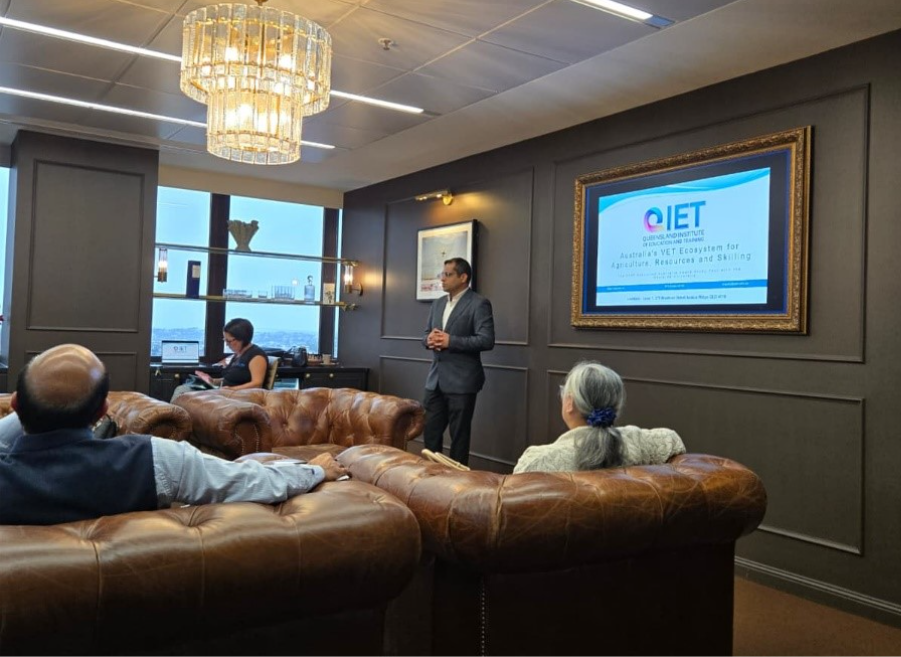
Project Partners’ Engagement in Brisbane
Dr. Shweta Singh and Dr. Tamara Jackson from the University of Adelaide brought together project partners for a comprehensive program at Brisbane’s Club of United Business in April 2026. The event welcomed an esteemed delegation from the Government of India’s Skills Ministry and Agricultural Authorities, who joined representatives from the Department of Employment Workplace Relations (DEWR), Queensland Institute of Education and Training (QIET), MINRES Training Institute, and a range of guest speakers. The focus was on advancing vocational education, governance, training innovation, and fostering international collaboration.
Forum Discussions and Knowledge Exchange
Throughout the day, participants engaged in dynamic discussions and Q&A sessions addressing the changing landscape of skills development and the Australian Vocational Education and Training (VET) framework. Representatives from DEWR offered insights into decision-making processes, implementation requirements, and quality assurance measures within Australia’s VET system. The open forum style encouraged collaboration, identification of new opportunities, and analysis of global trends shaping vocational education in both Australia and India.
Key Focus Areas
Conversations centred on Australia’s competency-based training model, the importance of industry-aligned skills, and the integration of emerging technologies such as virtual reality (VR) and augmented reality (AR) simulation-based learning. The use of MINRES’ proprietary AI-driven Training Management System was also highlighted as a key innovation within the sector.
Participants shared their perspectives on how Indian training authorities might adapt to evolving workforce requirements, improve learner engagement, and build stronger pathways between education and employment.
Firsthand Exposure and Future Collaboration
The intensive program provided delegates with direct exposure to Australia’s industry-led training system. It underscored the role of innovation and technology in shaping delivery and assessment practices, and reinforced the value of a joint Australia-India initiative in knowledge exchange. This collaboration is vital for developing a robust, future-ready vocational education system.